
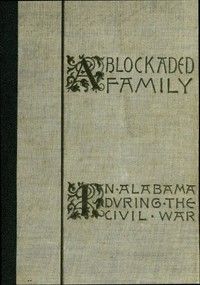
A Blockaded Family: Life in Southern Alabama during the Civil War by Hague
A Blockaded Family isn't your typical Civil War story. There's no cavalry charge or dramatic surrender. Instead, it’s a quiet, desperate account of how one woman, Parthenia Hague, and her family survived the Union blockade that cut off the South from everything—food, medicine, even cloth for clothes.
The Story
Parthenia Hague was a schoolteacher living on a plantation in southern Alabama when the war broke out. As the Northern navy tightened its blockade, ordinary life got weird. Coffee? Gone. Sugar? A dream. People started making ersatz coffee from sweet potatoes and okra seeds. Clothes wore out, so women beat nettles into fibers to make thread. Her family turned their farm into a survival station: picking cotton, carding wool, spinning yarn, and weaving cloth on looms they built themselves. They butchered hogs, grew corn, and prayed the Yankees wouldn't show up. It's not a hero’s journey—it’s about ingenuity and bare-knuckle grit.
Why You Should Read It
This book cracked me wide open because it shows how war isn't just about soldiers. Hague’s voice is matter-of-fact and sharp—she doesn't romanticize the “lost cause. She just tells you what she did to keep her people alive. I loved the little details: how they made doors from packing crates, or how neighbors hoarded salt. There’s a scene where they boil cotton seeds to make oil because they couldn't buy lamp oil. You feel the *creativity* born from desperation. Also, her perspective as a woman adds a layer you rarely see in male-centric history books—childbirth, sewing parties, keeping house while avoiding marching armies.
Final Verdict
If you're a history nerd who loves primary sources, grab this. But even if you just like survival stories (think Little House on the Prairie if Laura Ingalls faced a war), you'll be hooked. It’s also perfect for anyone who enjoys memoirs from women's perspectives—Hague’s practical, unsentimental tone feels refreshingly modern. Skip it if you want battle maps; if you want to taste acorn coffee and wear homespun dresses, dive in.
No rights are reserved for this publication. Feel free to use it for personal or commercial purposes.
Richard White
2 years agoBefore I started my latest project, I read this and the logic behind each conclusion is easy to follow and verify. It cleared up a lot of the confusion I had previously.
Susan Moore
1 year agoThis was exactly the kind of deep dive I was searching for, the data points used to support the main thesis are quite robust. Thanks for making such a high-quality version available.





Jessica Gonzalez
3 months agoI started reading this with a critical mind, the step-by-step breakdown of the methodology is extremely helpful for students. Finally, a source that prioritizes accuracy over hype.